Why is establishing a codified daily routine so critical? The primary problem it solves is decision fatigue. Every time you have to decide what to do next, you deplete a finite reserve of mental energy. By automating the ‘daily use’ of your time through a pre-determined framework, you free up cognitive resources for high-level problem solving and creative work.
Furthermore, a structured daily guide provides a safety net during chaotic periods. When motivation wanes—as it inevitably does—discipline takes over. A well-architected daily routine acts as an external skeleton that holds you upright and keeps you moving forward, ensuring that critical tasks are completed regardless of your emotional state.
This guide is designed to help you build that framework. It is not about turning yourself into a robot, but rather about creating the rhythmic consistency necessary for long-term growth. We will cover everything from the initial audit of your current habits to the specific execution of morning and evening protocols.
Prerequisites and Tools Needed
Before diving into the step-by-step process, you must assemble the necessary tools to track, manage, and execute your new routine. Having these items ready will reduce friction and signal to your brain that you are serious about this change.
- A Digital Calendar: Google Calendar, Outlook, or Apple Calendar for hard landscape scheduling.
- A Task Manager: Tools like Todoist, Trello, or a physical bullet journal to capture action items.
- A Note-Taking System: Notion, Evernote, or a simple notebook for capturing ideas and conducting reviews.
- A Timer: A physical kitchen timer or an app (like a Pomodoro timer) to manage work intervals.
- Water Bottle: To ensure hydration, a fundamental biological prerequisite for cognitive function.
Step 1: The Time Audit
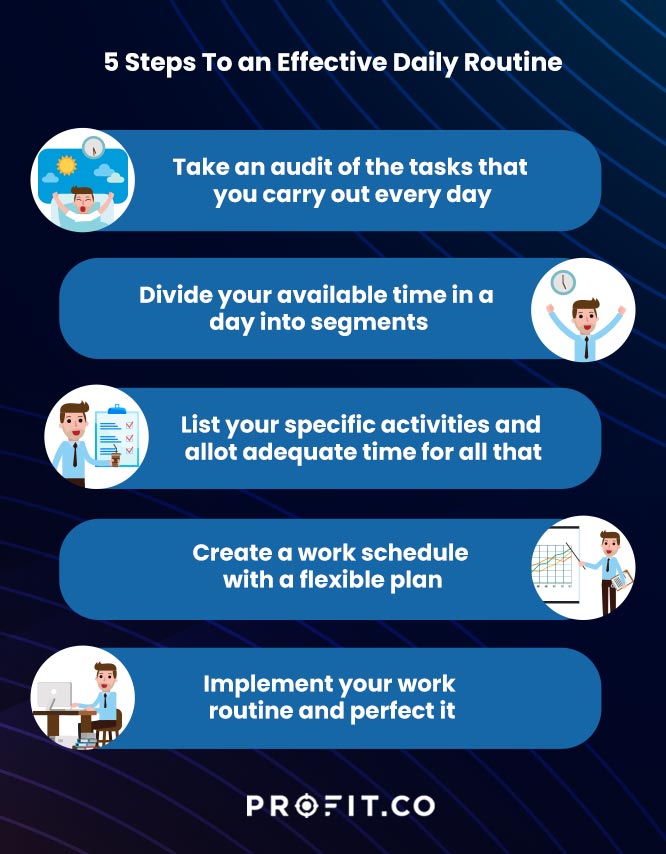
You cannot optimize what you do not measure. The first step to refining your daily use of time is to understand exactly where it is currently going. For three to five days, track every activity you engage in with 15-minute granularity.
Be honest during this phase. If you spend 45 minutes scrolling through social media in the morning, record it. If a ‘quick email check’ turns into an hour of reactive work, note that down. This data will reveal the ‘time leaks’ in your current schedule and serve as the baseline for your new routine.
Step 2: Define Your Non-Negotiables
Once you have your audit data, identify the pillars of your day. These are the activities that must happen for you to remain healthy and effective. Typically, these include sleep (7-8 hours), physical exercise, deep work blocks, and family/personal time.
Write these down and treat them as fixed appointments. In your new ‘daily use’ framework, these are the rocks around which the rest of your schedule (the sand) will fit. If you do not schedule them first, they will inevitably be pushed aside by urgent but unimportant tasks.
Step 3: Architecting the Morning Anchor
The way you start your morning sets the trajectory for the rest of the day. A successful morning routine should be viewed as an ‘anchor’—a sequence of actions that grounds you before the chaos of the world intervenes.
The Protocol: Wake up at a consistent time. Immediately hydrate with water to counteract overnight dehydration. Engage in some form of movement, whether it is a full workout or 10 minutes of stretching. Most importantly, avoid checking your phone for at least the first 30 minutes. This prevents reactive cortisol spikes caused by emails or news.
Step 4: The Deep Work Block
Schedule your most cognitively demanding task for the time of day when you are most alert. For most people, this is the late morning. This is your ‘Deep Work’ block. During this period, the daily use of your focus must be absolute.
Eliminate all distractions. Close your email tab, put your phone in another room, and use noise-canceling headphones if necessary. Work for 90 minutes on a single, high-impact project. This single step will likely produce 80% of your professional value for the day.
Step 5: Batching Shallow Work
Administrative tasks are necessary evils. Email, Slack messages, scheduling, and phone calls are ‘shallow work.’ The mistake most people make is letting these tasks bleed into every hour of the day.
Instead, batch them. Schedule two or three 30-minute blocks specifically for communication. Process your inbox to zero during these times, and then close it again. This compartmentalization prevents the constant context switching that destroys productivity.
Step 6: The Mid-Day Reset
Human energy is cyclical, following ultradian rhythms. You cannot maintain peak output indefinitely. Around midday, you must initiate a reset protocol. This involves stepping away from the screen.
Eat a nutritious lunch that won’t cause a glucose spike and subsequent crash. If possible, go for a 15-minute walk outside. The exposure to natural light and the physical movement helps reset your circadian rhythm and clears mental fog for the afternoon session.
Step 7: The Afternoon Sprint
The afternoon is often better suited for collaborative work, meetings, and creative brainstorming rather than heavy analytical lifting. Use this time to connect with your team, attend necessary calls, and wrap up loose ends.
If you find your energy dipping significantly, use the Pomodoro Technique: 25 minutes of work followed by a 5-minute break. This creates a sense of urgency and keeps momentum going when willpower is low.
Step 8: The Shutdown Ritual
Just as you have a morning anchor, you need an evening shutdown ritual to sever the connection between work and rest. This is crucial for psychological recovery. Without it, work residue lingers in your mind, affecting your sleep and relationships.
At a specific time (e.g., 5:30 PM), review your task list. Check off what you completed. More importantly, write down the top three priorities for tomorrow. This practice, known as the Ivy Lee method, allows your subconscious to process those tasks overnight and ensures you know exactly what to do when you wake up.
Step 9: Evening Restoration
The hours before bed should be dedicated to restoration. This is the ‘daily use’ of downtime. Avoid blue light screens at least an hour before sleep to protect melatonin production.
Engage in passive or active leisure that recharges you—reading fiction, spending time with family, or practicing a hobby. This is not ‘wasted’ time; it is the recovery period that makes the next day’s performance possible.
Common Pitfalls and Troubleshooting
1. Overscheduling: The most common error is planning every minute of the day with no buffer. Life is unpredictable. Always leave 20% of your day as ‘white space’ to handle unexpected fires or delays.
2. The ‘All-or-Nothing’ Mentality: If you miss your 6:00 AM wake-up and get up at 7:00 AM, do not scrap the whole routine. Simply pick up the schedule from where you are. Consistency is about the aggregate, not perfection on a single day.
3. Neglecting Physiology: You cannot out-schedule a bad diet or lack of sleep. If you are exhausted, your cognitive tools will be dull. Prioritize biological needs above productivity hacks.
Conclusion
Mastering the daily use of your time is a journey, not a destination. The routine you build today will evolve as your life circumstances, energy levels, and priorities change. The goal is not to create a prison of rules, but a scaffold for success.
Start by implementing just one or two of these steps—perhaps the morning hydration and the evening planning ritual. Once those become automatic, layer in the deep work blocks. Over time, these small, consistent actions will compound into profound professional success and personal balance. The best day to start is today.